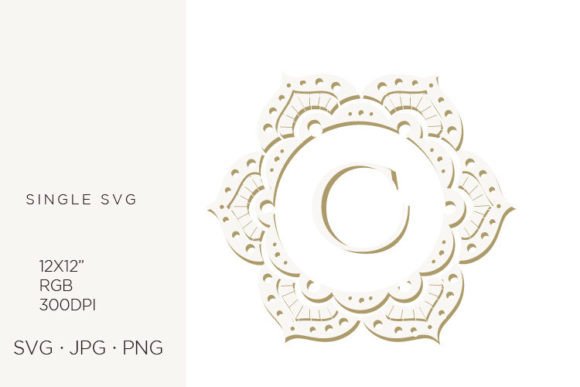
C Letter, Inside Floral Mandala Frame: A Designer's Guide to Quality and Usage
When you search for a monogram element that balances elegance with intricate detail, the C Letter, Inside Floral Mandala Frame often stands out as a compelling choice. This single vector artwork is more than just a decorative initial; it is a versatile foundation for branding, stationery, and personal creative projects. However, finding the right digital asset is only half the battle. Many creators download files without understanding the technical specifications or the limitations of their intended application, leading to frustrating results in print or web design. Understanding what makes this specific graphic effective—and where common pitfalls lie—can save you time, money, and wasted effort.
Understanding the Value of Vector Artwork
The primary appeal of the C Letter, Inside Floral Mandala Frame lies in its format. Created in Adobe Illustrator, this artwork is delivered as a vector file, which is fundamentally different from standard raster images like those taken by a camera. Vectors are built on mathematical equations rather than pixels. This distinction is crucial for anyone planning to scale the design up for large-format printing, such as wall art or banners, or down for small details like business cards.
Because the file includes an EPS version, you retain the ability to edit the paths, colors, and shapes without losing quality. The accompanying JPG and PNG files at 300 dpi provide immediate usability for quick previews or digital mockups. The 12x12 inch artboard size is a standard industry dimension that ensures the composition remains balanced regardless of how you crop or frame it. For professionals and hobbyists alike, this flexibility allows the same core design to serve multiple purposes, from a wedding invitation logo to a web header icon.
Common Mistakes When Choosing Digital Graphics
Despite the clear advantages, many users make critical errors when selecting and utilizing assets like the C Letter, Inside Floral Mandala Frame. One of the most frequent misunderstandings involves the difference between resolution and scalability. Beginners often assume that a high-resolution JPG (like the 300 dpi version included in the zip file) is sufficient for all print jobs. While 300 dpi is excellent for standard paper sizes, it becomes problematic if you attempt to enlarge the image significantly beyond its original dimensions. Once you stretch a raster image, it becomes pixelated and blurry, ruining the professional look of your project.
Another overlooked detail is the color mode. The files provided use an RGB color palette, which is optimized for screens and digital displays. If you plan to send your design to a commercial printer for items like invitations or handmade cards, relying solely on RGB can lead to unexpected color shifts. Printers typically require CMYK color profiles to ensure accurate ink reproduction. Ignoring this conversion step before sending your file to press can result in duller colors or hues that do not match your screen preview.
How File Format Choices Impact Your Results
The impact of these oversights extends beyond aesthetics; it affects efficiency and cost. If you discover too late that your floral mandala looks jagged on a large poster, you may have to restart the entire design process or pay for expensive reprints. Similarly, color mismatches can delay production schedules, especially for time-sensitive events like weddings or product launches. Using the wrong file type can also limit your editing capabilities. If you only work with the PNG file, you cannot separate the letter "C" from the floral elements to change the background or rearrange the layout. You are locked into the exact composition provided.
Furthermore, beginners often underestimate the complexity of intricate designs like mandalas. While the C Letter, Inside Floral Mandala Frame is beautiful, its detailed nature requires careful handling during the coloring process. Applying solid fills to every tiny petal without considering print limitations can cause clogging in some printing presses or excessive ink usage. It is essential to evaluate whether the level of detail suits your specific medium before committing to the design.
Practical Steps for Better Design Decisions
To avoid these issues, start by verifying your end goal before downloading any graphics. If your primary need is for web design, social media posts, or digital announcements, the included PNG and JPG files will likely suffice. Ensure you keep the transparency of the PNG intact so the mandala blends seamlessly with various website backgrounds. However, if your project involves physical goods like printed paper items, party decor, or wall art, prioritize the EPS file.
Here is a checklist to follow before finalizing your design:
- Check the Color Mode: Open the EPS file in Adobe Illustrator and convert the color profile from RGB to CMYK if you intend to print professionally. This ensures the vibrant florals translate accurately to paper.
- Test Scalability: Before printing a batch of invitations, create a small test print. Zoom in on the mandala details to ensure the lines remain crisp and do not bleed together.
- Verify Software Compatibility: Ensure you have access to vector-editing software. While the ZIP file includes raster formats for convenience, the true power of the C Letter, Inside Floral Mandala Frame is unlocked only when you can manipulate the vector paths.
- Consider the Background: Since the PNG has a transparent background, experiment with different textures or colors behind the letter "C" to see how the contrast holds up.
Maximizing Versatility Across Projects
Once you have navigated the technical setup, the possibilities for this single vector artwork are vast. Entrepreneurs can use the C Letter, Inside Floral Mandala Frame as a central logo element for boutique brands, beauty salons, or craft businesses. The organic flow of the floral elements softens the geometric shape of the letter, creating a welcoming and sophisticated brand identity.
For event planners and hobbyists, this graphic is ideal for customizing handmade cards and announcement flyers. Because the artboard is 12x12 inches, it fits perfectly into square scrapbook layouts or die-cut templates. You can easily duplicate the design, adjust the line weight for a minimalist look, or add gradients to give the flowers depth. The key is to treat the file as a modular component rather than a static image. By leveraging the editable nature of the vector format, you maintain control over the final output, ensuring that your creative vision is executed precisely.
Evaluating Quality Before Purchase
Before making a decision to buy or download similar assets, always review the file specifications provided by the creator. A reputable package should clearly state the inclusion of vector formats (EPS), high-resolution raster images (JPG/PNG), and the color mode used. Avoid listings that only offer low-resolution JPEGs, as these lack the versatility required for professional work. Additionally, check if the artwork is organized with clean layers. A well-structured file allows you to isolate the letter "C" or individual floral clusters, making customization much faster and easier.
By approaching the C Letter, Inside Floral Mandala Frame with a clear understanding of its technical requirements and potential applications, you transform a simple download into a powerful tool for your creative endeavors. Whether you are designing a logo for a startup or crafting a unique birthday invitation, paying attention to these details ensures your final product looks polished, professional, and exactly as you envisioned.